I came for a speech. I found a city working through its feelings in real time.
Jan 03, 20265:50 AM
Sign up for the Slatest to get the most insightful analysis, criticism, and advice out there, delivered to your inbox daily.
It was around noon when I stepped off the train, surfacing into Lower Manhattan’s particular brand of winter blight—when the cold is amplified by tall buildings that block out direct sun and funnel air directly onto your face. It was about 25 degrees, though the temperature felt theoretical once the wind got involved. Within minutes my ears had gone brittle, aching in that sharp kind of way that makes you briefly resent your parents for ever leaving the Middle East.
I followed a small group of South Asian aunties in industrial-grade puffers and bright yellow “Zohran” campaign beanies, which smartly functioned equally as political statements and survival gear. They led me toward the official public “block party,” a kenneled-off stretch of Broadway that I had optimistically imagined would involve warmth-adjacent amenities: food carts, coffee in little paper cups that burn your fingers just a bit, maybe even porta-potties. Instead, it was a wide, empty street hemmed in by police barricades and a few enormous screens. Music blasted. People stood around. That was it.
The aunties seemed genuinely delighted, bopping along to Bruno Mars as if this were the triumph of civic joy they had been waiting for since Election Day. I, meanwhile, realized that joy without circulation was not sustainable for me. I lasted maybe five minutes.
I cut north toward City Hall Plaza, where the actual inauguration was scheduled to take place.
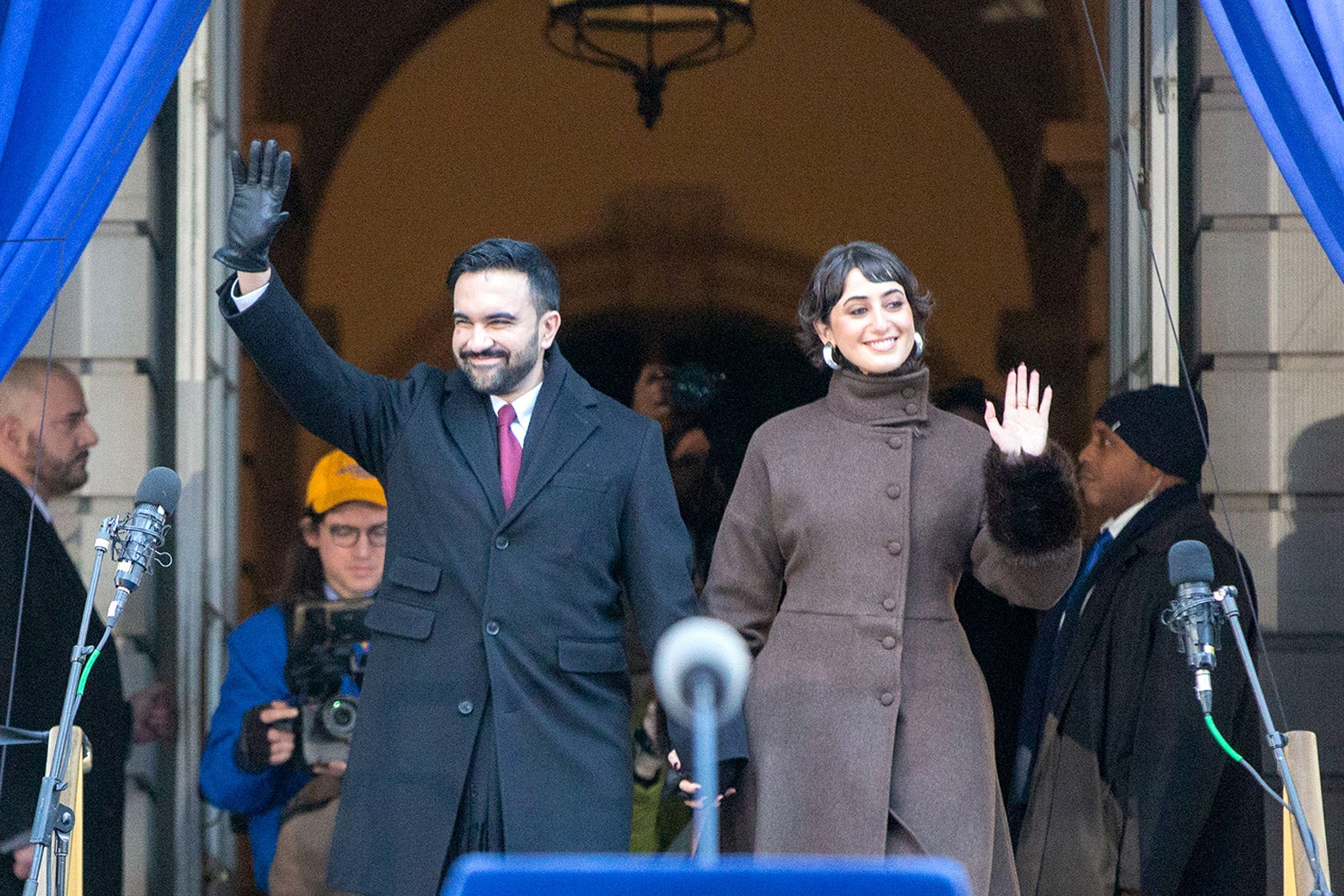
I was expecting a spectacle. Zohran Mamdani is a New York mayor of many firsts: the first Muslim, the first South Asian, the first African-born, the first millennial. In the middle of the Trump era—which has been particularly hostile to every one of those identities—I wanted to see how that collision landed in person. I was curious how ordinary New Yorkers, from the people who powered his rise to City Hall to those who opposed it and everyone in between, would experience a moment that already felt larger than a single election.
What I found instead was something messier and more revealing. New York was working through its feelings in real time. Pride and paranoia crossed paths on the sidewalk. Joy and cynicism hovered in the frozen air. As always, the city was a layered collage best understood through the small encounters and fleeting scenes unfolding at street level as history happened in the background.
Along the barricades, I passed a small group of protesters waving Israeli flags. I approached one woman for a quote. She immediately bristled, waving her hand in my face and telling me to leave, then threatening to call the police—an escalation that felt unnecessary given that we were already surrounded by officers.
Another protester, who declined to provide her name, apologized quietly for the interaction. She told me that some of the others were “kind of crazy.” She stood a few feet away from them, holding her flag politely, not chanting or yelling. She said she was worried about Mamdani’s “background” and wanted to show support for Israel in defiance of a mayor who had broken with New York’s long tradition of unyielding support for the Israeli government. She sounded less angry than anxious, fixated on Mamdani’s outspokenness on what experts have called a genocide, and her nervousness for the future of Zionist New Yorkers.
By the time I reached the security entrance, the program was supposed to start in less than an hour. Volunteers urged attendees to take their seats, but they milled around, greeting old friends, hugging, shouting names across rows of white folding chairs. Unlike the public block party, this felt like a gathering of the campaign’s engine—organizers, supporters, donors, artists, electeds—the people who had powered what many still described as the biggest political upset since Donald Trump’s 2016 win.
Just inside the checkpoint, a woman smiled and said, “Hi, I’m Marisa.” Another chimed in: “Hi, I’m Natasha.” It took me a second to register that they were Marisa Tomei and Natasha Lyonne. Neither was surrounded by handlers or slated to speak. They were simply there, guests like everyone else, bundled up and waiting for things to begin. Both were warm and unfussy, radiating the kind of ease that comes from being completely at home in a crowd like this. The inauguration hadn’t even started, and already it was a vibe.
Hundreds filled the seats. There was music, chatter, the low buzz of anticipation. And yet, nothing about this place was warm. I was uncontrollably shivering.
I started mentally cataloging everything I hadn’t brought with me: a fluffy scarf, a hat that actually covered my ears, maybe even a balaclava, though I doubted that would play well for an Arab at an inauguration, even with the mayor being a Muslim.
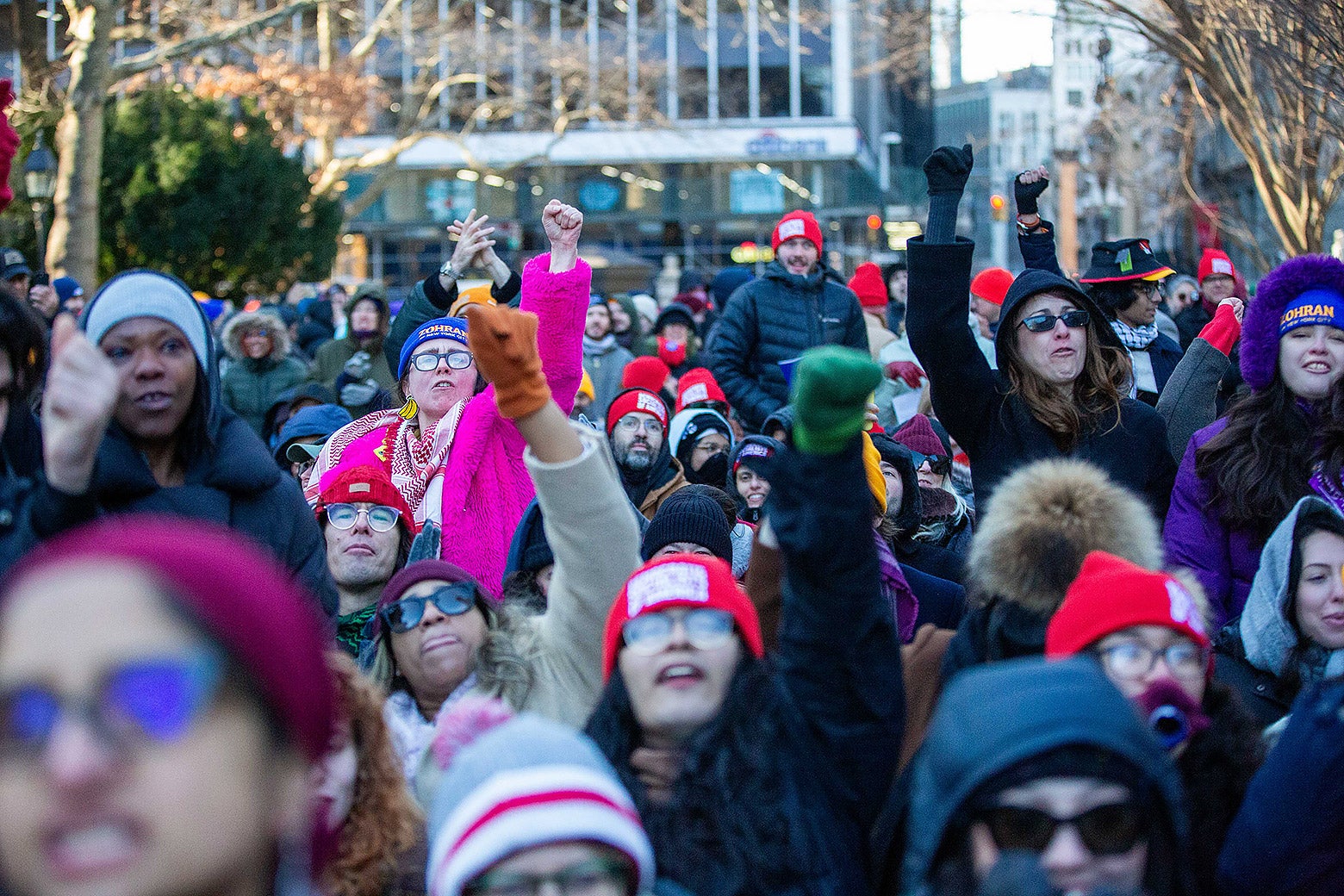
Everywhere I looked were red Democratic Socialists of America beanies, pulled low, doing the quiet but essential work of insulation. I considered asking for one, though I want to be clear: I wanted one because my head was so cold I could feel my thoughts slowing down. Still, there was something remarkable about the destigmatization of a previously dirty word in politics out in force on the lawn of City Hall.
Then I saw him. A Sikh man a few rows from the front unfurled a blanket with the calm confidence of someone who had planned for this exact scenario. He wrapped himself completely and settled into his chair. At regular intervals, he poured himself a cup of steaming hot chai from his thermos. I watched with envy the way the steam rose into the air. I’d have traded my camera for a sip.
The crowd itself felt carefully curated: actors, activists, organizers, journalists, all packed together. Walton Goggins, of HBO’s The White Lotus, hovered nearby, visibly delighted to see Lyonne. Model Waris Ahluwalia looked impeccable, as expected. Kareem Rahma, of Subway Takes fame, fresh off the best year of his career, filmed the scene on his caseless iPhone. Mustafa the Poet was there too, unmistakable and stylish.
Then came the faces I knew from my reporting in 2025: Mohsen Mahdawi and Mahmoud Khalil, Palestinian students of Columbia University with green cards who had been detained by Immigration and Customs Enforcement for their activism. Linda Sarsour, a Brooklyn-born activist, sat near the front in a striking purple hijab. Simone Zimmerman, a Zeteo contributor and a central focus of the film Israelism. Writer Suzy Hansen and I exchanged smiles as we took it all in.
It was brutally cold. Sitting felt impossible. I kept moving, using my camera as an excuse. “If I sit, I’ll miss the moment,” I kept telling people. I ran into familiar faces—Asad Dandia, Husein Yatabarry, Dr. Debbie Almontaser—Muslim New Yorkers I know as part of the civic ecosystem that helped propel Mamdani to success.
As I continued to circle the crowd, ducking between rows of folding chairs, I caught the same refrains over and over. Visitors chatted as they tried to process what they were watching unfold.
“I’ve never seen this much negative coverage of any New York mayor. Fearmongering and what ifs count as journalism now?” one said. Another agreed. “Even if he can’t accomplish everything—because, let’s be honest, they’re going to make his life hell—at least he’s given us a vision of what different could look like,” they noted. “Anyone who has to contort themselves this hard to hate the most likable political figure imaginable clearly has a persecution fetish.”
A Muslim woman in hijab said, “If the Democratic Party had half Mamdani’s integrity, the fascists wouldn’t be winning.” An excited fan waving a handmade Mamdani sign exclaimed, “Zohran delivered Bernie clapping in a beanie—already the best mayor!” Another reveler asked: “Wait. Is that Susan Sarandon? That’s definitely Susan Sarandon. And John Turturro. Right?”
I also overheard some fierce debates between visitors in DSA hats. “This feels like Obama all over again, and that scares me. They’re going to sabotage him at every turn and then blame him when things don’t magically work,” said one. “Can we stop saying ‘free’ transit? We pay for it. Libraries, schools, buses, that’s what taxes are for.” Said another: “Socialists used to hold office in this country. They helped win labor rights we take for granted,” They added: “MAGA keeps saying they hate corrupt billionaire elites—but they’re terrified of a guy who wants to tax the rich? What did you think an ‘everyman’ mayor was supposed to do?”
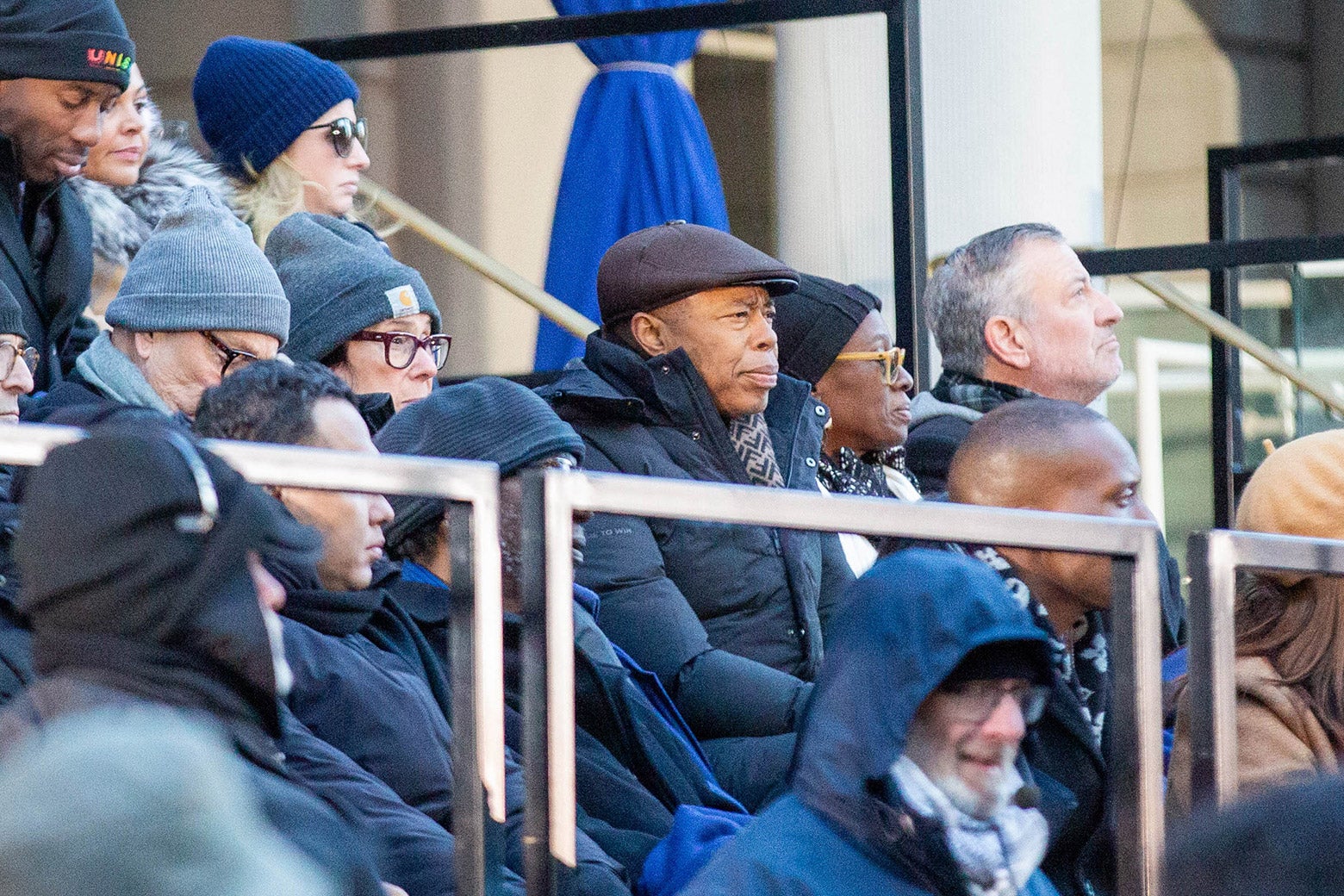
(At one point, people around me began whispering excitedly about outgoing Mayor Eric Adams. Apparently, he looked miserable. Someone said, “He’s having a terrible time.” Someone else replied, “Good.” I had snapped a photo earlier in which he appeared to be pouting. I showed it to them. They leaped with joy. It was petty. It was human.)